Q: What is a ratchet puller used for?
A: A powerful pulling capability that's ideal for hoisting motors, shafts and gears, vehicle recovery, stretching wire and fences, farm, ranch construction and so much more. Landscaping, construction, farm work, forestry, hitching and more.
Q: What are the advantages of a ratchet puller?
A: Simplicity: ratchet pullers are straightforward to use and do not require external power sources such as electricity or hydraulic systems. Portability: These pullers are often compact and lightweight, making them portable and suitable for on-site repairs or maintenance.
Q: Is the ratchet puller easy to operate?
A: Control: Users have direct control over the adjustment process, allowing them to make fine adjustments as needed during the extraction process.
Complexity: Ratchet pullers may require more effort and time to set up and adjust compared to self-adjusting pullers.
Q: How much weight can a ratchet puller pull?
A: Makes it easier to move an item by mechanical advantage. Available in all cranking types - hand crank, loop, ratchet styles. Designed for use with cable or strap. Capacities: 400 to 4,000 lbs.
Q: What is ratchet puller?
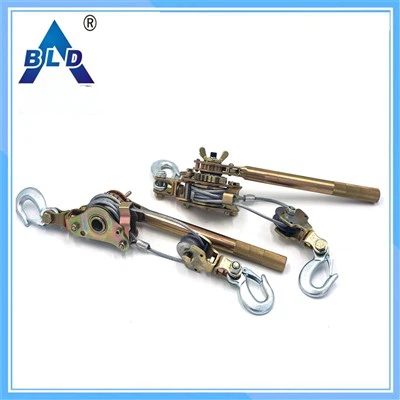
A: A ratchet puller, also known as a come-along or cable puller, is a versatile hand-operated tool used for lifting, pulling, and tensioning heavy loads. It consists of a ratchet mechanism that allows for incremental movement and a cable or chain with hooks at both ends.
The ratchet puller typically has a sturdy frame with a handle for operation. One end of the cable or chain is attached to the load, while the other end is secured to a fixed anchor point. By pulling the handle, the ratchet mechanism engages, allowing the user to apply force and gradually move the load.
Q: How does a ratchet puller work?
A: Ratchet pullers work by applying mechanical force to extract or remove objects such as bearings, gears, pulleys, and other press-fit components from shafts, holes, or other mounting surfaces.
Q: What are the maintenance requirements for ratchet pullers
A: Since ratchet pullers are expensive, you want them to last as long as possible. Most types of ratchet pullers require regular maintenance to stay on top of their game- some more so than others. Check the maintenance guidelines carefully to make an informed decision. It's best to pick a low-maintenance ratchet puller to avoid extensive upkeep.
Q: How portable is the ratchet puller
A: Ratchet pullers are lightweight and easily portable, designed for flexibility in various locations and temporary setups. Their simple mechanical operation and absence of electrical components allow for easy transport and deployment in different work areas, including workshops, maintenance tasks, and remote locations where electrical access may be limited. This portability enhances their versatility and makes ratchet pullers ideal for applications where mobility and flexibility are critical considerations.
Q: What is the function of ratchet puller?
A: Ratchet pullers are dismounting tools, steel made, that remove parts such as bearings, coupling hubs, rings, or gears from a shaft. The pullers have legs, typically two or three, which circle the back or inside of a part. They also have a forcing screw that centers up against the end of a shaft.
Q: What are the three types of ratchet pullers?
A: Types of ratchet pullers. In most industrial or construction settings, there are three types of ratchet pullers used: manual, electric, and pneumatic. Manual ratchet pullers operate by hand, while electric and pneumatic hoists utilize electrical and air compression as sources of power.
Q: What are the requirements for the load capacity of the ratchet puller?
A: Different types of ratchet pullers have different load capacities. The rule of thumb is to ensure your loads don't exceed the rated capacity at any point. Overloading can do more than damage your equipment- it can jeopardize site safety.
Q: How much maintenance do ratchet pullers require?
A: Since ratchet pullers lack electrical components, they have far simpler maintenance needs. This maintenance involves:
● Inspection and lubrication of mechanical parts including chains, hooks, and gears.
● Checking and tightening of bolts and fasteners.
● Monitoring load-bearing components for wear and tear.
● Periodic testing of safety mechanisms such as brakes and load-limiting devices.
● Routine cleaning and maintenance to prevent corrosion and ensure smooth operation.
Q: How do I use a ratchet puller safely?
A: To use a ratchet puller safely:
Always follow the manufacturer's instructions
Wear proper personal protective equipment (PPE)
Ensure the load is properly secured
Use the correct attachment points and hooks
Avoid overloading the ratchet puller
Q: How does a ratchet puller work?
A: The hoist typically consists of a hand chain, a chain block or lifting mechanism, and a hook for attaching to the load. You can use accessories such as beam clamps and trolleys, to streamline your operation. ratchet pullers are commonly used in a variety of settings, including construction, manufacturing, and maintenance, and are particularly useful in situations where power or electricity is not available, or where a power hoist is not necessary or practical. They are simple to operate and require minimal maintenance, making them a reliable and cost-effective lifting solution.
Q: How to choose ratchet puller?
A: Now that you know the different types of ratchet pullers, it's time to decide which one best fits your lifting project. Multiple factors can influence your choice of a ratchet puller, including:
1. Load capacity
Different types of ratchet pullers have different load capacities. The rule of thumb is to ensure your loads don't exceed the rated capacity at any point. Overloading can do more than damage your equipment- it can jeopardize site safety.
2. Lift height
Lift height is the maximum distance between the floor and the hook when the ratchet puller is at rest. Account for the distance between the hook when it is raised and lowered. Also, remember to consider headroom- the distance between the ratchet puller suspension and the hook when it's raised.
3. Environment and conditions
The lifting conditions play a crucial role in directing which type of ratchet puller you should use. For example, air ratchet pullers are more conducive to dangerous, fast-paced environments because they are explosion-proof and have a 100 percent duty cycle. Carefully consider where you'll be using your ratchet puller before adding it to your cart.
4. Ease of use
Make sure you're comfortable using the ratchet pullering equipment type before settling on it. Discuss your options with a rigging ratchet puller supplier in case you don't know what to choose.
5. Maintenance requirements
Since ratchet pullers are expensive, you want them to last as long as possible. Most types of ratchet pullers require regular maintenance to stay on top of their game- some more so than others. Check the maintenance guidelines carefully to make an informed decision. It's best to pick a low-maintenance ratchet puller to avoid extensive upkeep.
Q: Can I use a ratchet puller for pulling vehicles?
A: Yes, ratchet pullers can be used for pulling vehicles, but it is essential to choose a model that is designed for vehicle recovery and to follow proper safety procedures.
Q: How do I choose a puller size?
A: The Reach should always be equal to or greater than the part you are pulling.
The Ratio of the Tonnage to Shaft Diameter is 10:1. This means that if you have a shaft diameter of 1.5", you should us a 15 ton Puller.
The Ratio of Shaft Diameter to the Center Bolt Diameter is 2:1.
Q: How do you measure a puller?
A: Puller Spread: Puller spread is twice the distance from the center bolt to the pulling surface of the jaw. In choosing the proper puller make certain the puller has a large enough spread to attach to the object being removed.
Q: What is the safety factor of a manual ratchet puller?
A: Hoists are designed to provide a 4 to 1 safety factor. Supporting structures and load-attaching devices used in conjunction with this hoist must provide an adequate safety factor to handle the rated load, plus the weight of the hoist and attached equipment.
Q: How to use ratchet puller?
A: Before using any of these devices, make sure they match the load requirements as well as the lifting height necessary for the job at hand. The devices must exceed the weight of the load you're lifting for safe operations.
1. Attach device to anchor point
You want to attach the ratchet puller to a solid anchor point before lifting begins. Most lifting hoists include an upper hook on top of the gear housing separate from the chain itself that secures the device for lifting. The anchor provides necessary stability in order for it to work.